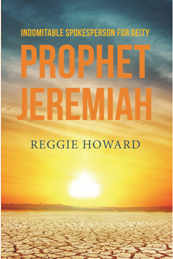
Indomitable Spokesperson for DEITY – Prophet Jeremiah
Where to start?
This book portrays a most remarkable human
being. Vulnerable, strong, brash, funny.[1] Derided then, misjudged
today.
Meet him. Get to know him. You will never
look back.
Indomitable?
He is called “indomitable” and here is why.
His Divine message enraged the powers of his day. They boiled. Religious
leaders publicly insulted him, stripped him, whipped him, locked him in stocks.
Neighbors he grew up with wanted him gone. Crowds rioted for his death. Kings
hunted him, jailed him, destroyed his work, threw him in a muddy pit, jailed
him again. But he never quit!
What motivated him?
He was desperately trying to prevent his
nation and people from disappearing.
Does Deity Communicate?
Yes, the Bible describes God as a
communicator. He speaks in the Bible as early as the third verse(Gen.
1:3, “Let there be light.”) and is still speaking in the second to last verse
(Rev. 22:20, “Yes, I am coming soon”).
Why?
He pursues connection; meaningful,
interactive engagement with His human creatures. He craves to bless everyone
through mutually beneficial, interactive relationships.[2] Yes, God is above all else a
Relational Being.[3] His
relational nature permeates Jeremiah’s prophetic work. Meet the Living God!
Deity weeps. Deity pleads. Deity rebukes. Deity
warns and disciplines. And through his spokesperson he repeatedly, tirelessly,
works for reconciliation with his rebellious people.[4]
Note a few of the Lord’s statements:
She [Jerusalem]
spouts evil like a fountain. Her streets echo with the sounds of violence and
destruction. I always see her sickness and sores. 6:7.[5]
Am I the one they
are hurting? Most of all they hurt themselves to their own shame. 7:19.
Why do these people
stay on their self-destructive path? 8:5.
And responses the people fired back:
Save your breath. I’m in love with these
foreign gods, and I can’t stop loving them now! 2:25.
At last we are free
from God! We don’t need him anymore! 2:31.
Let’s destroy this
man and all his words… Let’s cut him down, so his name will be forgotten forever.
11:19.
The Lord, through his chosen spokesperson, spoke for decades, reaching out in love and
compassion; aiming to woo his beloved people back to relationship. “With
unfailing love I have drawn you to myself.” 31:3.
Tug-a-war
The Divine Communicator is passionate[6],
relentless[7], and
demanding.[8] His
spokesperson is swept into the harrowing task of mediating between Him and the
belligerent recipients[9] of
these communications.
There is a dynamic, massive, 3-party
“tug-a-war” erupting throughout the book of Jeremiah. Recognizing and tracking
these dynamics illuminates the book and the parties involved. There is nothing
flat or boring when the book of Jeremiah is permitted to speak for itself.[10]
What’s Ahead?
Detailed and
comprehensive study of Jeremiah’s scroll awaits later publication.[11]
It is a massive labyrinth that takes courage and endurance to scope out. Yet, it
is packed with gold, diamonds and precious stones that demand multiple
coverage.
The starting
point is to get to know the remarkable man himself. The environment he lived
and breathed and served. The duties he was asked to perform. And the callus,
vengeful responses of those in power and in all strata of society.
Let’s endeavor to
encounter the wily character himself, spokesperson for Israel’s God, Prophet
Jeremiah.
“Although it is not
an easy task simply to read the Book of Jeremiah… nevertheless it is an
indisputable fact that… a partial but striking picture of the prophet emerges
from the pages of the book named after him. Unlike many of the biblical
prophets, who remain perpetually as figures in the shadows of history, Jeremiah
stands out as a truly human figure. He is torn between faith and doubt, he is
deeply involved in the contemporary affairs of his time, and, in the pages of
this book, he passes from youth to old age against the backdrop of the history
of his era.”[12]
Three Parts of This
Book
Jeremiah “the man” is ample study. His life
was unique and diverse; its study is therefore multifaceted. This book
comprises three major sections:
I. Stumbling onto the National Stage
Jeremiah started his work with a sterling
ally sitting on Judah’s throne.[13] But
catastrophe struck, and he was asked to contribute to the late king’s funeral
by composing the dirges. Now he finds himself in the national spotlight.
This section gives an easy-access “brief” on the life and times of Jeremiah. Areas of background include the
historical, political, social, religious, and economic conditions of those
times. Creative Nonfiction[14] is used in chapters 1, 4, 5, and 7, for enjoyable reading and
better retention.
II. Waves of Opposition
God’s spokesperson met trauma and abuse for much of his 40 years of service. It came
from his Master’s rebellious people and their leaders. Priests, prophets and
kings contributed. Creative Nonfiction is again the medium for chapters 2-7.
The prophet never withdrew from his people or society, nor from speaking out on
behalf of the marginalized and neglected. His predicaments drew him closer to
the Living God; the theme of the next section.
III. Dialogues with Deity
Nowhere else in
scripture is there such a gold mine; cataloging 40 years of interactive,
growing relationship between the Living God and his fallible ambassador. These
interactions are interlaced deliberately into the text of Jeremiah; but
overlooked by most of the Christian world.[15]
Here lies a 2-party dialogue that progresses throughout Jeremiah’s large
book. Relationships have difficulties, ebbs and flows, but mature individuals
value relationships above the “costs” involved. And this is what we find, both
parties commit to success in the relationship. Turbulence strains, conflict
arises, but the relationship supersedes.
Appendices
These three sections
are followed by 10 Appendices, covering a range of important and related
topics.
“Let’s try to discover Jeremiah, this deeply
human and attractive prophet, whose oracles comprise struggle and courage,
torments and happiness, rejection and solidarity, disappointment and hopes,
doubts and passion.”[16]
[1] Yes, funny.
[2] God is by nature one who
“blesses”. He seeks relationships not for selfish reasons but because he
desires to bless and improve everyone’s existence.
[3] “The relational God of Jeremiah is
no aloof God, somehow present but detached. God is a God of great passions
(pathos); deep and genuine divine feelings and emotions are manifest again and
again. Sorrow, lament, weeping, wailing, grief, pain, anguish, heartache,
regret, and anger all are ascribed to God in Jeremiah.” Fretheim, Terence E. Smyth & Helwys Bible Commentary:
Jeremiah. Macon, Georgia: Smyth & Helwys, 2008. p. 33. To ponder the
complexities involved here, please read Appendix 7, Two Sticky Issues: Weeping and a Conditional Future.
[4] “God is jealous for your heart,
not because he is petty or insecure, but because he loves you. The reason why
God has such a huge problem with idolatry is that his love for you is
all-consuming. He loves you too much to share you.” Kyle Idleman, @KyleIdleman
[Twitter], 11, 26, 2018.
[5] Unless
otherwise indicated, all scripture quotations are from: New Living Translation, second edition. Copyright © 2004 by Tyndale
House Publishers, Inc. All rights reserved.
[6] Jer. 14:17; 44:6.
[7] Jer. 31:3; 44:4.
[8] Jer. 7:5-7.
[9] Jer. 44:16-17.
[10] “It is often easy for us to read
millennia-old accounts that describe death and devastation, misery and grief,
suffering and tears, and to remain unmoved. After all, the written text can
seem so impersonal and distant, and we do not actually hear the cries of the
wounded and dying – in reality, the people involved are complete strangers to
us – nor do we smell the smoke rising from the flames of destruction … We tend
to demonize the villains, lionize the heroes, and seek primarily to gain
theological or practical insight from the (sometimes) stern dealings of God
with his people, forgetting that these were real people, too, with real hopes
and dreams and all too human disappointments and hurts.” Brown, Michael L.;
Ferris, Paul W. The Expositor’s Bible
Commentary: Jeremiah, Lamentations. Grand Rapids, MI: Zondervan, 2010,
Kindle Edition, Location 1742.
[11] This book is produced as part 1 of
a trilogy. The second book title: Masterful
Communication from DEITY – The Book of Jeremiah. Third title: Urgent, Critical, Paradigm-Shifting
Communiques from DEITY – Via Jeremiah.
[12] Craigie, Peter c., Kelly, Page H.,
Drinkard, Jr., Joel F. Word Biblical
Commentary, Vol 26, Jeremiah 1-25. Dallas TX: Word Inc., 1991,
p. xxxvii.
[13] King Josiah receives the highest
endorsement of all the kings of Israel and Judah. “Never before had there been
a king like Josiah, who turned to the LORD with all his heart and soul and
strength, obeying all the laws of Moses. And there has never been a king like
him since.” 2 Kin. 23:25.
[14] This is a well-documented genre in
modern literature, with guidelines, code of ethics, and taught in Universities.
For further information see Appendix 1, What
is Creative Nonfiction?
[15] Indeed, these dialogues are among
the more difficult threads to uncover and follow in scripture.
[16] Prevost, Jean-Pierre. How to Read the Prophets. NY, NY:
Continuum Publishing Company, 1997, p. 73.







 Hear Divine Words